What supply does a hot tub need?
13 amp plug-in or 32 amp hard-wired? What electrical supply your hot tub needs, where the isolator goes, and what to sort out before the delivery lorry turns up.
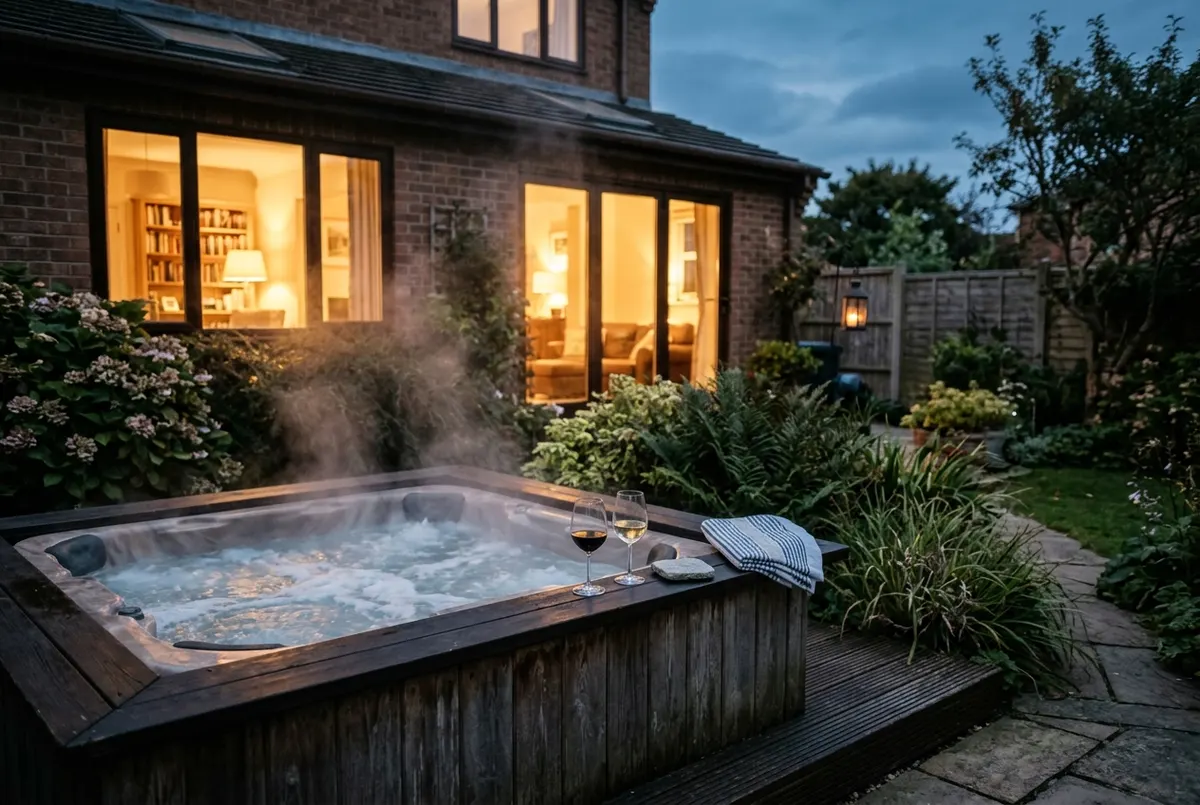
Most hard-wired hot tubs need a dedicated 32 amp supply in armoured cable from the consumer unit, with RCD protection and a rotary isolator fitted within sight of the tub. Small plug-in tubs run from a 13 amp socket but need their own RCD-protected outdoor socket. Houses with a PME earth usually need an earth rod as well.
- Hard-wired tubs: dedicated 32 amp supply
- Plug-in tubs: RCD-protected 13 amp outdoor socket
- Dedicated supply from £520 including VAT
- Book the electrician before the delivery date
Every spring the weather turns, the garden centres put hot tubs by the door, and a week later our phone rings because a tub has been delivered and there is nowhere safe to plug it in. This guide covers what a hot tub actually needs from your electrics, so you can get it sorted before the tub arrives rather than after.
Plug-and-play vs hard-wired tubs
Hot tubs come in two electrical flavours, and the difference matters more than the colour of the shell.
A plug-and-play tub runs from an ordinary 13 amp plug. An amp is a measure of how much electric current something draws; a kettle takes about 13 amps, which is also the most a standard UK socket can give. Inflatable tubs and the smaller rigid ones work this way. They are cheap to set up, but because the heater has to share that 13 amps with the pump, they heat slowly and struggle to hold temperature once the wind gets up off the sea.
A hard-wired tub has no plug. It is connected permanently to its own circuit, usually rated at 16, 20 or 32 amps depending on the size of the heater and pumps. Most of the proper acrylic tubs sold on the Fylde coast want a 32 amp supply, which lets the heater and the jets run at the same time. The manufacturer’s spec sheet will tell you which your tub is, and it is the first thing we ask for.
What a dedicated supply includes
Whichever type of tub you have, the safe way to feed it is a dedicated supply: a circuit that does nothing else, run from your consumer unit (the fuse box) to the tub. For a hard-wired tub it is the only option. For a plug-in tub it means a proper outdoor socket on its own circuit, rather than a lead through the door. A standard dedicated supply has four parts.
The circuit itself. A new way (a spare slot) in the consumer unit, with a breaker sized to the tub. If your fuse box is an older one with no spare ways, or it has no RCD protection, that is where the job gets bigger.
RCD protection. An RCD, a residual current device, is a safety switch that cuts the power in a fraction of a second if electricity starts flowing somewhere it should not, such as through water or a person. A hot tub is a bath of water in the garden with electrical equipment bolted to it, so this is not optional. The wiring regulations require RCD protection rated at 30 milliamps for hot tub supplies, and we normally fit an RCBO, which is a breaker and RCD combined in one device, so a fault on the tub cannot take the whole house out.
A local isolator. This is a switch near the tub, usually a weatherproof rotary switch on the wall or a post, that lets you or an engineer cut the power to the tub without going indoors. Tub manufacturers expect one for servicing, and it is how you make the tub safe if something goes wrong.
The cable. Outdoors, the cable needs to survive lawnmowers, spades, frost and salt air. We use steel wire armoured cable, known as SWA, buried in a trench or clipped along a fence or wall. It is tougher than the flat grey cable inside your house and designed for the job.
Where things can go
The wiring regulations, BS 7671, treat hot tubs and swimming pools as a special location, because water and electricity are a bad mix. Section 702 of the regulations sets out zones around the water, and what is allowed in each.
The practical effects for a homeowner are these. Nothing electrical goes inside the tub or within reach of someone sitting in it unless it was designed for that purpose and supplied with the tub. Sockets and switches are kept a set distance back from the water, and anything within a couple of metres of the tub has to be of a type that is suitable for the zone. The isolator goes outside the zones but close enough to be useful, typically on a nearby wall. Outdoor sockets near the tub need to be the enclosed, weatherproof kind with RCD protection.
We also look at what is already there. Garden lighting, a patio socket or a shed supply installed years ago may sit inside the zones once the tub goes in, and sometimes it has to move. A quick site visit sorts that out before anyone digs a trench.
The seafront adds its own twist. Salt air corrodes cheap metal fittings in a couple of winters. On South Shore and along the front at Cleveleys we use plastic or marine-grade enclosures and stainless fixings, and we try to keep joints out of the weather altogether.
Before the tub arrives
The tub is usually the easy bit. The groundwork is what catches people out, so here is the list we send to customers once they have placed an order.
Get the spec sheet. The supply rating (13, 16, 20 or 32 amps), whether the tub needs a single supply or two, and the length of the flex it comes with. Send it to us before you fix a delivery date.
Plan the base. A full hot tub weighs well over a tonne and needs a level concrete pad or a deck rated for it, with the cable entry point lined up.
Plan the cable route. From the consumer unit, out through a wall, then buried or clipped. A run of up to 15 metres is standard; 30 metres across a long garden in Hambleton means more cable, more digging and a higher price.
Check the consumer unit. Send us a photo of it with the lid open. We can usually tell from that whether it has a spare way and RCD protection, or whether an upgrade is needed first.
Book the electrician early. Deliveries bunch up in May and June. Booking the electrical work for the week before delivery, not the week after, means the tub is warm the day it arrives rather than sitting empty in the garden. Many retailers will not commission a tub without a tested supply and a certificate.
Costs
Our guide price for a dedicated hot tub supply of up to 32 amps is from £520 including VAT. That covers the new circuit at the consumer unit, RCD protection, a weatherproof rotary isolator, up to 15 metres of SWA cable, the final connection to the tub, testing and the certificate.
What moves the price up: a cable run longer than 15 metres; a lot of digging or lifting paving; a consumer unit that needs replacing first (from £495 for a new metal unit with RCBOs); or a tub that needs two separate supplies. What keeps it down: a clear route, a tub close to the house, and a spare way in a modern consumer unit.
A plug-in tub fed from a new RCD-protected outdoor socket is cheaper, from £145, though we still want to see where the socket sits relative to the water.
Using extension leads (don’t)
We see it most summers. A tub on the lawn, an orange extension reel out of the utility room window, the lead lying across wet grass. Please don’t.
Extension leads are not rated to carry a hot tub’s heater for hours at a time. The cable warms up, the plug warms up, and reels that are not fully unwound get hot enough to melt. The lead has no protection from mowers, feet or rain. Add bare feet, wet ground and a tub full of water and you have the one combination an electrician never wants to see.
A plug-in tub should go into a weatherproof outdoor socket with RCD protection, fitted by an electrician, with the tub’s own flex reaching it without strain. That is a small job and it turns a worry into something you never think about again.
Need a hand?
If you have ordered a tub, or you are thinking about one, send us the spec sheet and a photo of your fuse box and we will tell you what you need and what it will cost. Details are on our hot tub supplies page, and you can reach us through the contact page.