What the job involves
Emergency lighting is the lighting that comes on by itself when the mains fails, so people can find their way out. Fire alarm systems are the detectors, call points, sounders and panel that warn people a fire has started. Both are life-safety systems, both are governed by British Standards, and both have to be installed, tested and recorded properly or they are not doing their job.
The standards are BS 5266 for emergency lighting and BS 5839 for fire alarms. You do not need to know them in detail; the point is that they set out where fittings and devices must be, how long batteries must last, how often everything must be tested, and what has to be written down. The Regulatory Reform (Fire Safety) Order 2005 makes the person in control of the premises responsible for all of that. In practice, that is the hotel owner, the practice manager, the head teacher or the care home manager, and the fire risk assessment is the document that says what the building needs.
We design, install, test and maintain both types of system. Our electricians have worked on them since 2004, and the work is covered by our NICEIC Approved Contractor registration.
What we do on the day
For a new installation we start from your fire risk assessment and the layout of the building. We work out escape routes, where people might be when the lights go out, and which rooms need their own emergency fitting. For fire alarms we agree the category of system with you: an L category protects life, an M category is manual call points only, and the categories in between cover progressively more of the building. The design is written down and the installation follows it.
For testing, our visits follow the pattern the standards set out. Emergency lighting gets a monthly function test, which proves each fitting switches on when the mains is cut, and an annual full-duration test, which proves the battery lasts the three hours the design usually demands. Fire alarms get a weekly test by you, using a different call point each week, and a service by us every six months, when we check each detector, call point and sounder, the panel, the batteries and the connections to any remote monitoring.
Every visit ends with the log book. The log book is the record that you have tested the systems, and the fire officer will ask to see it. We fill it in on the day, note any faults, and leave a copy of the certificate with you. Where the building has no log book, we supply one and set it up.
What it costs
An annual emergency lighting test starts from £120 for a small premises with up to about a dozen fittings. Larger buildings are priced per fitting, and fire alarm servicing is priced by the number of devices and the type of panel. Where we do both at the same visit the combined price is lower than two separate ones. Installation work is quoted from a site survey.
Who it’s for
Any building where the public or employees could be caught by a mains failure or a fire. On the Fylde that means Blackpool’s hotels and guest houses on the Promenade and the streets behind it, where a licence depends on the systems being tested; care homes in Lytham, Thornton and Poulton, which CQC inspects; schools around Garstang and across Wyre, where we work in holidays and after hours; shops and arcades, dental and medical practices in St Annes, and the offices on the business parks at Poulton and Thornton, where landlords usually ask the tenant to prove testing at each lease review.
Testing on the Fylde coast
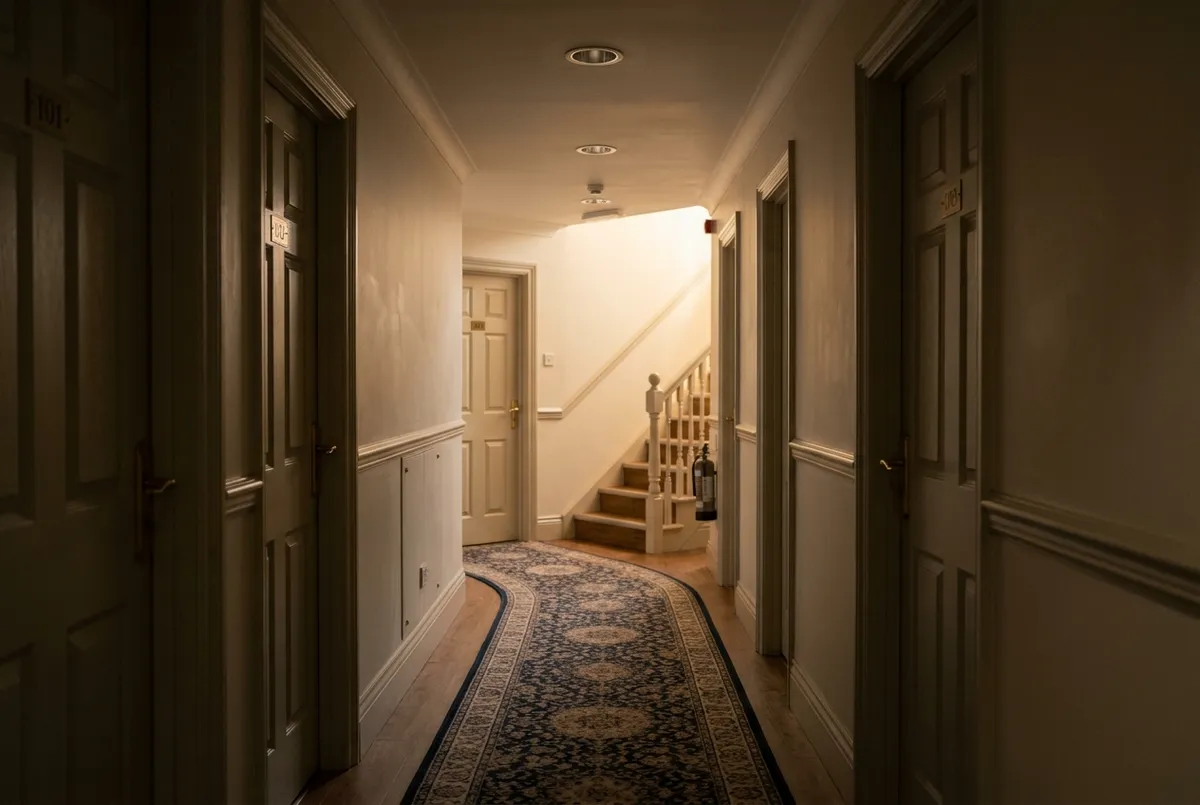
Blackpool’s older hotels present a particular challenge. Long corridors, half-landings, basements and extensions mean escape routes are rarely straight, and we often find emergency fittings that are present but not where someone leaving in the dark would need them. Many were fitted before the current standard and have never had a full-duration test, so the first visit finds batteries that last twenty minutes instead of three hours. In care homes, residents who cannot move quickly change the design: more fittings, longer duration, and alarm sounders arranged so staff know where to go. Units at Fleetwood docks and farm buildings near Garstang are often high, dusty and cold, which shortens battery life and means detectors need cleaning more often. We have worked in all of them, and we keep the records so you do not have to think about it until the next visit is due.