EV charger installs: what's involved and what it costs
What happens during a home EV charger install on the Fylde coast, from the survey to the first charge, what moves the price up or down, and which grants are still open.
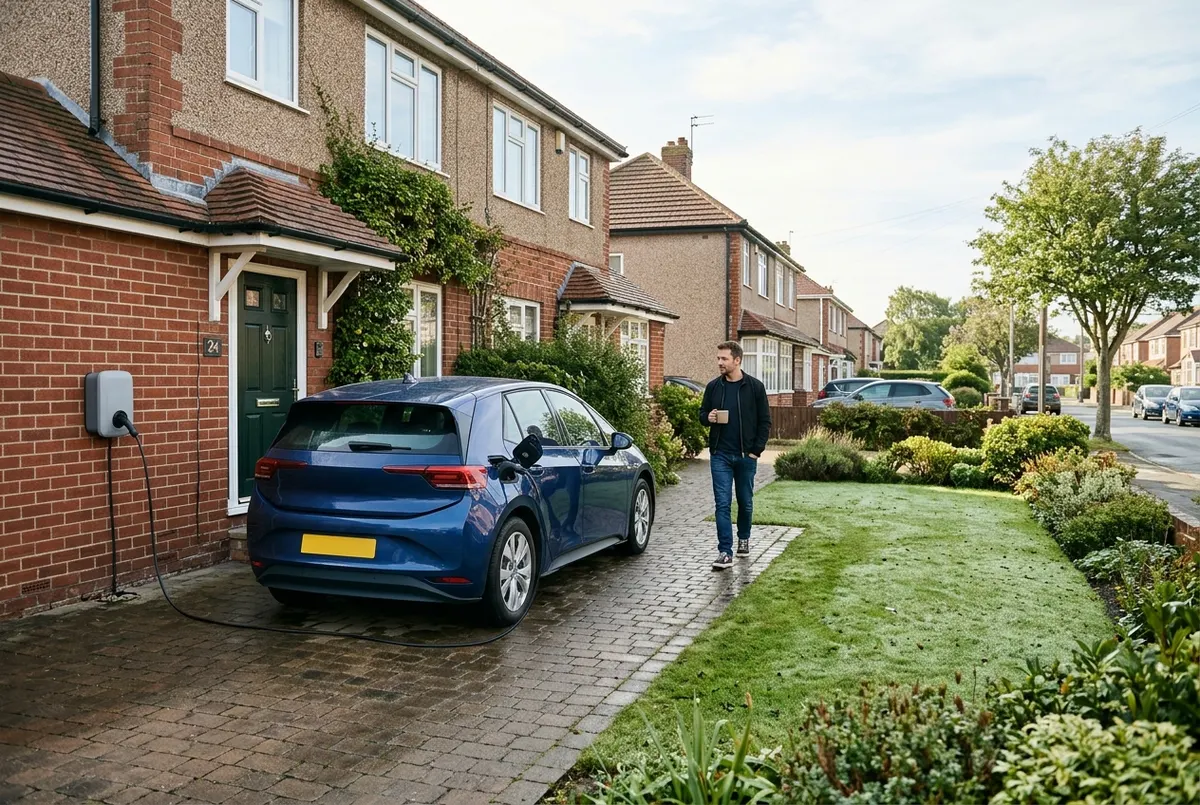
A home EV charger install usually takes half a day. The electrician surveys the supply, runs a cable from the consumer unit to the charger, adds protection for the PME earth if needed, fits the unit and registers it. A 7 kW charge point supplied and fitted starts from around £849 including VAT.
- 7 kW charge point from £849, supplied and fitted
- Includes up to 10 m of cable
- Most installs finished in half a day
- OZEV grants still open for flats, renters and landlords
Can you have a home charger?
The first thing people ask about EV charger installation cost is the price. The first thing we ask is where the car will park. A home charger needs to be on a wall or post within reach of the car’s charging socket, and that nearly always means off-street parking: a driveway, a garage or an allocated space. If you park on the road outside a Blackpool terrace, a charger with a cable trailed across the pavement is not something we will fit. Some councils now allow cable gullies set into the pavement, so ask yours first.
The second thing is the supply. A standard home charger draws 7 kW, roughly what an electric shower takes, but it may run for hours. Most houses on the Fylde coast can cope with that, and we check before we quote rather than after.
The third is earthing. Most homes round here have a PME supply, where the earth comes in on the supply cable. For a car charger outdoors the wiring regulations, BS 7671:2018+A2:2022, require extra protection in case that earth ever fails, because a person touching the car bodywork could be at risk. Most modern chargers have that protection built in. Where they do not, we drive an earth rod into the ground beside the charger instead.
The survey
We survey every install before booking it, usually from photographs and a short phone call. We need to see the main fuse, the meter, the consumer unit, which is the fuse box in everyday language, and the spot where the charger will go.
The main fuse is the one the electricity network owns, by the meter, usually rated at 60, 80 or 100 amps. A charger adds a steady 32 amp load, so we work out the maximum demand of the house, which is what everything could draw at once, and check it fits. A 60 amp fuse with an electric shower, an electric cooker and a charger is tight. The answer may be to ask the network to upgrade the fuse, which is often free, or to fit a charger that throttles itself when the house is busy.
We also tell the network operator, which in Lancashire is Electricity North West. For a standard 7 kW charger the notification goes in after the install and does not need approval first. For larger chargers or a weak supply, we apply before.
Then we look at the cable route from the consumer unit to the charger. A short run through a garage wall is simple. A run from under the stairs of a 1930s semi in Poulton, through two rooms to the far side of the drive, is not, and it is the biggest thing that moves the price.
Install day step by step
An ordinary install takes half a day. The electrician confirms the position of the charger with you and marks the cable route. The power is switched off while the new circuit is connected at the consumer unit. Every charger goes on its own dedicated circuit with its own protective device, including RCD protection, which cuts the power if electricity leaks where it should not. Nobody should ever run a charger from an existing socket circuit.
The cable is run and clipped or hidden, the charger is fixed to the wall, and the power goes back on. The electrician tests the new circuit, sets up the charger’s app with you and plugs the car in to check it charges. You get an Electrical Installation Certificate recording the test results, and because a new circuit is notifiable work under Part P of the Building Regulations in England, a Building Regulations Compliance Certificate follows from our scheme a few weeks later.
Before we leave, we show you how to stop a charge, how to lock the charger against passers-by, and where the isolator is.
What it costs
Our standard 7 kW install is from £849 including VAT, supply and fit. That covers the charger, a cable run of up to 10 metres, the connection, the testing, the certificates and the network notification.
What pushes the price up is predictable. A cable run beyond 10 metres is charged per extra metre, and runs that go underground across a garden in armoured cable cost more again. An earth rod where the charger has no built-in protection adds a little. The big one is the consumer unit. If your fuse box is an old rewireable type, or is full, there is no safe way to add a circuit to it, and it needs replacing or a small second unit fitting beside it. A replacement starts from £495 and benefits every other circuit in the house.
A three-phase supply, unusual in a house but common on farms and small businesses, allows a 22 kW charger at a higher price. For most drivers 7 kW is plenty: it adds roughly 25 to 30 miles of range an hour, so a car left on overnight is full by morning.
Grants
The grant that used to pay towards a charger for any homeowner closed in 2022. What is left is targeted, so check whether you qualify before you buy.
The EV chargepoint grant is for people who rent their home or own a flat. It pays up to 75 per cent of the cost, capped at £350, and you need off-street parking that belongs to the property. The installer applies for you and knocks the money off the invoice.
Landlords can claim a similar amount towards chargers at properties they let, with a limit on how many each year, and a separate grant covers groundwork for shared car parks at blocks of flats. We see both used by landlords with holiday lets in St Annes, where guests increasingly look for a charger.
There is also a newer grant for households without off-street parking who want a charger with a council-approved cross-pavement cable channel.
The grants are run by the government’s Office for Zero Emission Vehicles, and we are an authorised installer under the scheme, which is a condition of claiming. The amounts and rules change, so check gov.uk before you rely on a figure here.
Smart charging rules
Since 30 June 2022 every home charger sold in Great Britain has had to be a smart charger under the Electric Vehicles (Smart Charge Points) Regulations 2021. That means it connects to the internet, can be set to charge at particular times, defaults to avoiding the peak hours of 8am to 11am and 4pm to 10pm until you change it, and adds a short random delay when it starts, so that thousands of cars do not all switch on at the stroke of midnight.
None of this stops you charging when you want. It does mean the charger needs a Wi-Fi or mobile signal where it is fitted, and a wall at the far end of a long bungalow in Cleveleys does not always have one. We check the signal during the survey and suggest a booster where it is weak. The smart features are also where the savings are: an off-peak EV tariff from your supplier can bring a full charge down to a few pounds.
Tethered vs untethered and other choices
A tethered charger has its own cable permanently attached, usually 5 or 7.5 metres. You walk up, plug in, done. An untethered charger has just a socket, and you use your own cable. It looks tidier and works with any car. Most people with one car choose tethered. Most people with a shared driveway or a holiday let choose untethered.
Think about where the charging socket is on your car, and on your next car, because the charger should reach it without the cable crossing a path. And think about solar panels if you have or plan them: several chargers can be set to use only the surplus from the roof, which on a bright day in Lytham is a very cheap way to drive.
Need a hand?
Our EV charger installation page has the price, what changes it and the questions we are asked most. For a quote, send a photo of your fuse box and your parking space through our contact page and we will come back with a figure, not a visit you have to wait in for.